

Window or Aisle?
A window into how interesting people travel—their rituals, discoveries, insights, pet hates and occasional wrong turns.
Sylvia Longmire
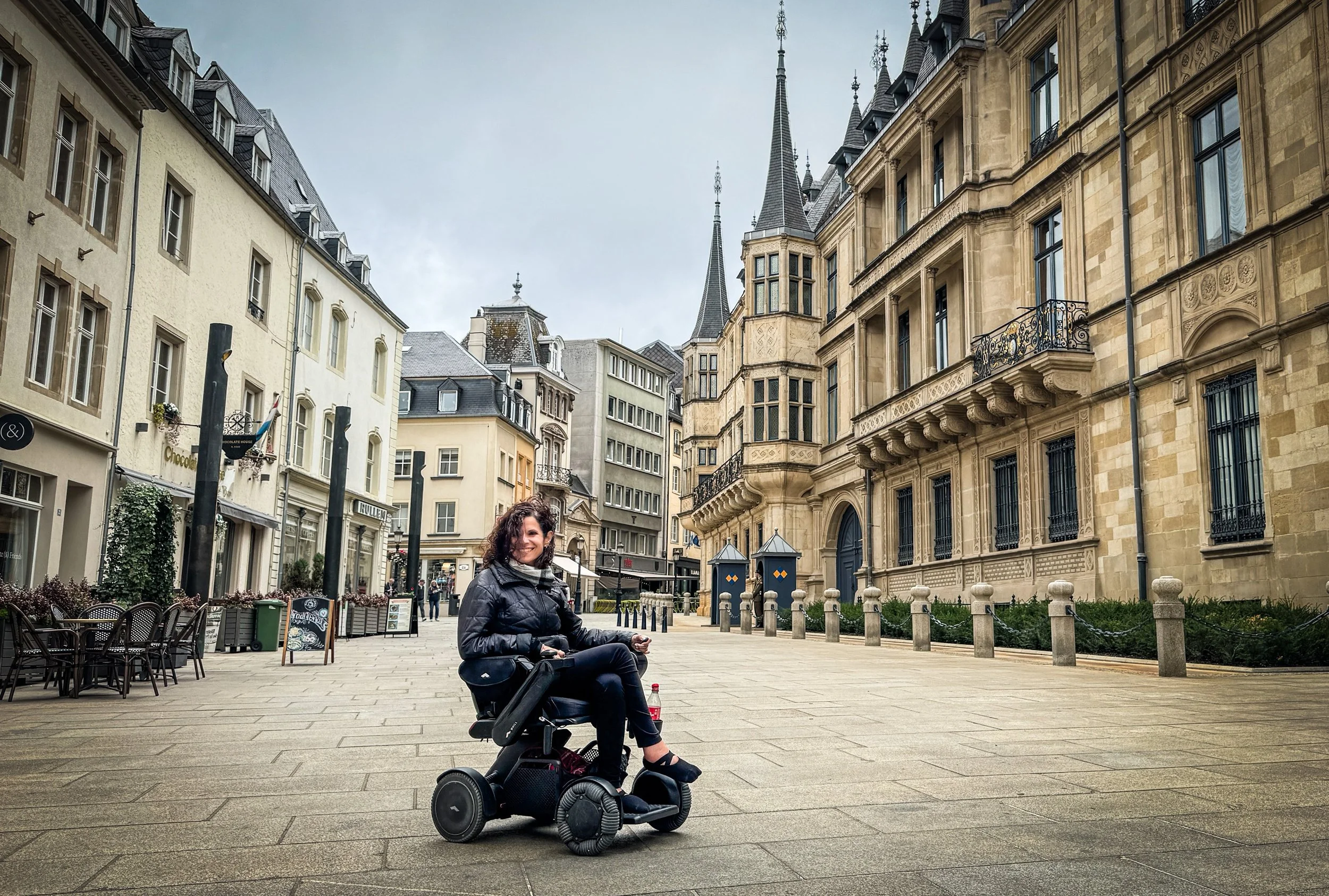
Sylvia Longmire is an award-winning accessible travel writer, photographer, and documentary filmmaker. She is also a service disabled Air Force veteran and full-time wheelchair user who has visited 59 countries and all 50 states, most of those solo in her wheelchair. In addition to writing about the accessibility of her destinations for her award-winning Spin the Globe travel blog, she produces films that center people with disabilities, and advocates for their increased representation in media. Sylvia’s writing can be found in the New York Times, Lonely Planet, the Orlando Sentinel, and TripAdvisor. She’s an accomplished TEDx public speaker, and manages an accessibility consulting business.
Every traveller has their own preferences when it comes to flying. Once you’ve settled on board, what makes the difference between a flight you endure and one you genuinely enjoy?
Because of my multiple sclerosis, I have pretty severe leg spasms and long flights can be absolute misery if I can’t get comfortable. If I’m able to get business class where I can fully recline or put my legs up in a comfortable position, then I can actually enjoy myself.
What’s one travel-related item that might seem completely ordinary to somebody else but that you’d never dream of leaving home without?
A grabber. I usually travel by myself, and I don't want to have to call the front desk to send somebody to reach for something for me if I drop it, more if it's too high up. For example, the showerhead being placed too high or the remote control falling under the bed.
Do you think there’s a slightly different version of Sylvia Longmire who emerges when you’re travelling – perhaps more adventurous, curious, or willing to take chances than the Sylvia at home?
I'm definitely more willing to try new things. I always have the attitude that I don't know if I will ever be coming this way again, so I want to absorb and do as much as I can while I am there.
You’ve written about travelling in places as different as Dubai, Iceland, and Alaska. Which destination has surprised you the most, and what was the reason?
Fargo, North Dakota. I went there to visit my 50th state, and it was the easiest city in North Dakota to get to. I imagined it would be relatively compliant because of the ADA (Americans with Disabilities Act). But I was so pleasantly shocked to discover that so many stores and restaurants had automatic door openers, which are not legally required. There was even one for an interior door in the art museum! What an amazing way to make wheelchair users feel welcome in a city that's definitely out of the way.
Has there ever been a moment on your travels when you’ve looked around and thought, how on earth did I end up here?
I'm laughing because I ask myself that all the time! And I will never forget the first time it happened. I was on my first Alaska cruise, and I found a helicopter tour company that had an accessible experience, with a lift to get me from my wheelchair to the backseat of the helicopter. We landed on a glacier, and while everyone was wandering around on the ice, I was by myself in the helicopter just looking around at the scenery like I had landed on another planet. And I literally said to myself out loud, what the F am I doing here, lol.
Have you ever experienced a moment somewhere that was so extraordinary you deliberately put your camera away because you didn’t want anything to interrupt it?
I was a classically trained pianist, and started playing at age 7. Because of my multiple sclerosis, I haven't been able to play the piano in a long time but I have a huge passion for classical music. Vivaldi's Winter is one of my favorite pieces, and many years ago I was in Prague for several days. It just happened that a string quartet was putting on a small concert at the City Hall and I managed to snag a ticket. By pure coincidence, Vivaldi's Four Seasons was part of the program, and when they got to Winter, it was like time stopped and nobody was there in that room except for me. I definitely had to wipe away some tears.
Your photography books are titled The View from Down Here. Has using a wheelchair changed not just how you move through a destination, but what you notice and choose to photograph?
Sitting lower down than everyone else is both a blessing and a curse. My view is obstructed pretty frequently, but I also noticed a lot of things closer to the ground that other people don't. I actually just made a documentary short film about this point of view that has been accepted into several film festivals and won an award, and it goes by the same name!
When an airline, airport or hotel gets accessibility absolutely right, what does that experience feel like from the traveller’s perspective – beyond simply being able to use the service?
It feels like I'm not just an afterthought. I feel like I was expected there, like they value my time and money and customer experience. I absolutely feel seen as a person.
Have you ever flown with an airline that genuinely exceeded your expectations in how it accommodated your needs as a wheelchair user? If so, which airline was it, and what did they do that made the experience stand out?
Singapore Airlines is absolutely phenomenal, and there's a good reason why they're usually at the top of the list every year for airline awards. I'll never forget I was flying to Singapore from Christchurch, and as always I was nervous about my wheelchair not getting damaged. After getting accommodated in my seat, someone from the ramp crew found me on the plane and showed me a photo of my wheelchair and how it had been secured in the hold to give me peace of mind. I will never forget that.
You have considerable experience travelling in Europe. Is there something European countries generally do better than the United States when it comes to accessibility, or vice versa?
This may sound like a minor thing to most, but I love that emergency pull cords are ubiquitous in Europe, from hotel rooms to public bathrooms. I usually travel solo, and while I always have my phone nearby, it gives me that extra layer of security knowing that if I fall in the bathroom or fall out of bed, I have a quick way to notify somebody that I've had an emergency. I have never seen one anywhere here in the United States.
Europe has wonderful historic buildings, narrow streets, and occasionally unforgiving cobblestones. Do you think destinations with centuries of heritage can successfully balance preserving their character with making themselves genuinely accessible to everyone?
Absolutely, and I've seen it dozens and dozens of times all across Europe. I mean, I've been to most European capital cities, and even Pompeii was made accessible! It's all about some creative thinking and financial investment.
Has your professional understanding of security risks ever persuaded you to avoid a destination that you would otherwise have loved to visit?
Absolutely, this is critical for me as a woman in a wheelchair usually traveling solo. Without naming names, there are several regions, usually developing countries, where it's just not safe for women to travel by themselves, and while I would love to visit, it's just safer that I don't.
If someone who had recently become a wheelchair user told you that their travelling days were over, what would you most want them to understand?
I would tell them that it's intimidating for sure and it may seem impossible, but it's purely about learning a different skill set, and taking the baby steps to feel comfortable with new experiences. Getting over the fear is 100% the hardest part, and you can do that by having the information you need about your destination.
If you could revisit one single day from all your travels, with no need to change anything about it, which day would you choose?
I went on a second Alaska cruise a couple of years ago, but this time with my teenage sons. I did get another helicopter tour that landed on a glacier. But this time, I got to see them hiking on that glacier, drinking the purest water that was ice cold, taking photos, and just looking around and marveling at being on that same alien landscape I had first experienced seven years earlier. Being able to share that experience with my children is something I will never forget.
Further information
To discover more about Sylvia Longmire’s travels, photography, and advocacy for accessible travel, visit her award-winning website, Spin the Globe.
You can also explore Sylvia’s solo wheelchair travel memoir, available on Amazon, and learn about her latest documentary project, Walking Dreams, which is currently seeking funding.